By: Jeremy Rose (Smart Chatham) and Carole Houk (Briar Chapel Community Association)
Five years ago, on December 20, 2021, the Chatham County Board of Commissioners stood at a critical land-use crossroads. On a narrow 3–2 vote, the Board approved a 184-acre expansion of the Compact Communities Ordinance (CCO) boundary map along Parker Herndon and Morris Roads.
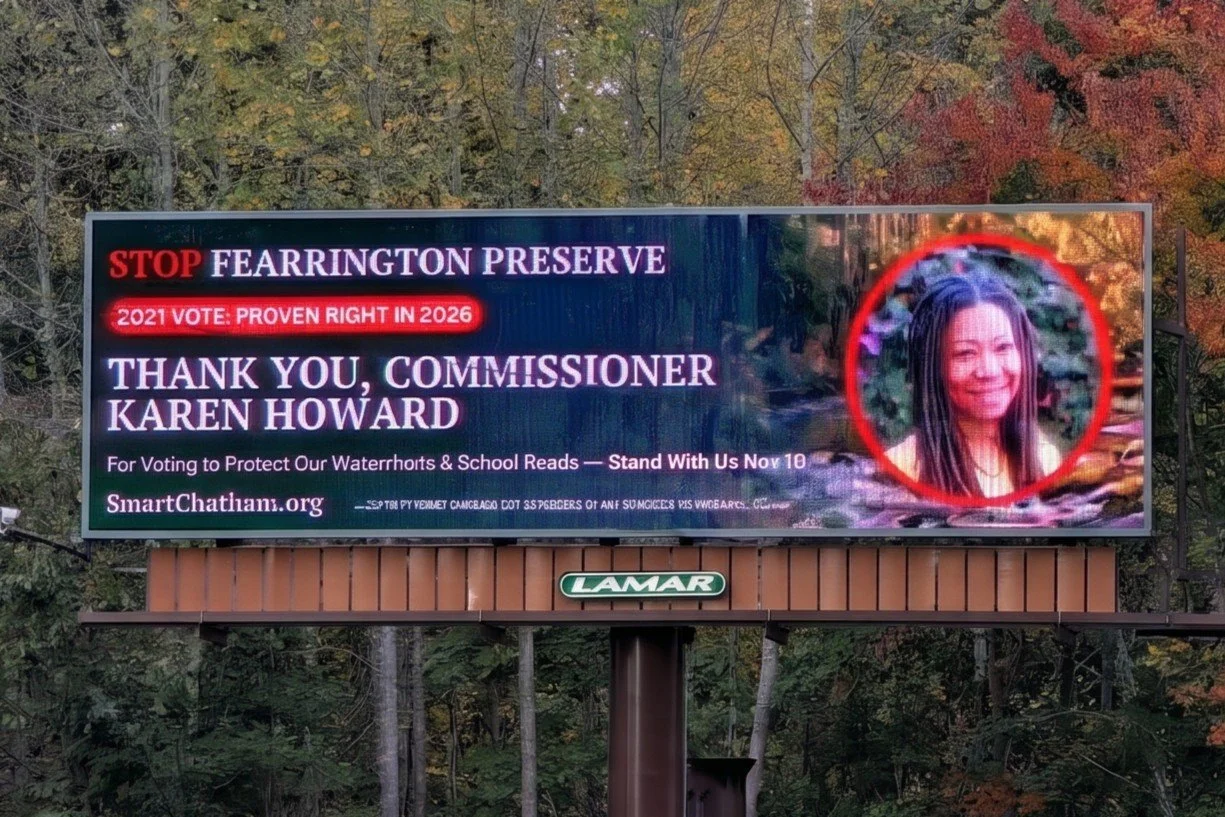
That evening, Commissioners Franklin Gomez Flores and Karen Howard cast courageous "No" votes. They saw through the speculative promises and warned that expanding high-density zoning boundaries into rural Baldwin Township without guaranteed wastewater solutions, adequate road networks, or plan consistency was a grave mistake.
Today, as the active 2026 Fearrington Preserve Conditional District Rezoning (Case CD-CC-2026) comes before the Board of Commissioners for a final vote on November 16th, history has proven Commissioners Gomez Flores and Howard completely right.
The developer’s plan, which seeks double-density Conditional District Compact Community zoning for 630 units on 365 acres, exposes every flaw warned about in 2021:
Severe Traffic on Rural School Corridors: The project is projected to dump over 6,500 new daily vehicle trips onto narrow two-lane collector routes, specifically Andrews Store, Parker Herndon, and Morris Roads. These exact roads serve as daily lifelines for four local schools: Chatham Grove Elementary, Margaret B. Pollard Middle, Woods Charter, and Willow Oak Montessori.
Wastewater & Watershed Risks: Lacking public utility connections, the applicant proposes a private Membrane Bioreactor (MBR) wastewater plant and 35+ acres of effluent spray fields on tight Vance and Helena clay subsoils upstream of flood-prone Pokeberry Creek. Furthermore, the developer’s claimed stream restoration "benefit" collapsed after the adjacent Briar Chapel HOA passed a unanimous August 2026 resolution refusing to participate in the Pokeberry Creek Mitigation Bank and Restoration Project associated with Fearrington Preserve.
Erosion of Public Benefits: Rather than fulfilling the spirit of a true walkable Compact Community, the developer treats community benefits as an afterthought. To satisfy the county's affordable housing mandate, the applicant proposes donating land that was the site of a former hog lagoon, relegating future affordable housing residents to compromised acreage while reserving prime land for market-rate units. Simultaneously, they are asking to waive core ordinance rules by slashing required commercial space by ~77% and cutting roadside viewshed buffers by 50% along Parker Herndon and Morris Roads.
On October 6, 2026, the Chatham County Planning Board thoroughly audited these 2026 updates and voted 8–3 to recommend DENIAL. Their recommendation echoed the exact principles Commissioners Gomez Flores and Howard stood for in 2021: high-density sprawl does not belong in sensitive rural watersheds on overburdened school roads.
We owe a debt of gratitude to Commissioner Franklin Gomez Flores and Commissioner Karen Howard for having the vision to vote "No" on the original 2021 map expansion. As the Board of Commissioners prepares for the final November 16th vote, Chatham County residents hope we can count on their continued leadership, and that the entire Board will join them in voting NO to deny the 2026 Fearrington Preserve rezoning application.
Chatham County deserves progress, but progress must follow the rules, protect our schoolchildren, and preserve our natural heritage.
Jeremy Rose is a representative of Smart Chatham. Carole Houk writes on behalf of the Briar Chapel Community Association.