Resources, Site Plans & Master Campaign FAQ
Review official site plan comparisons, recorded Chatham County Commissioners' public hearings, our AI-searchable source document notebook, and detailed fact sheets.
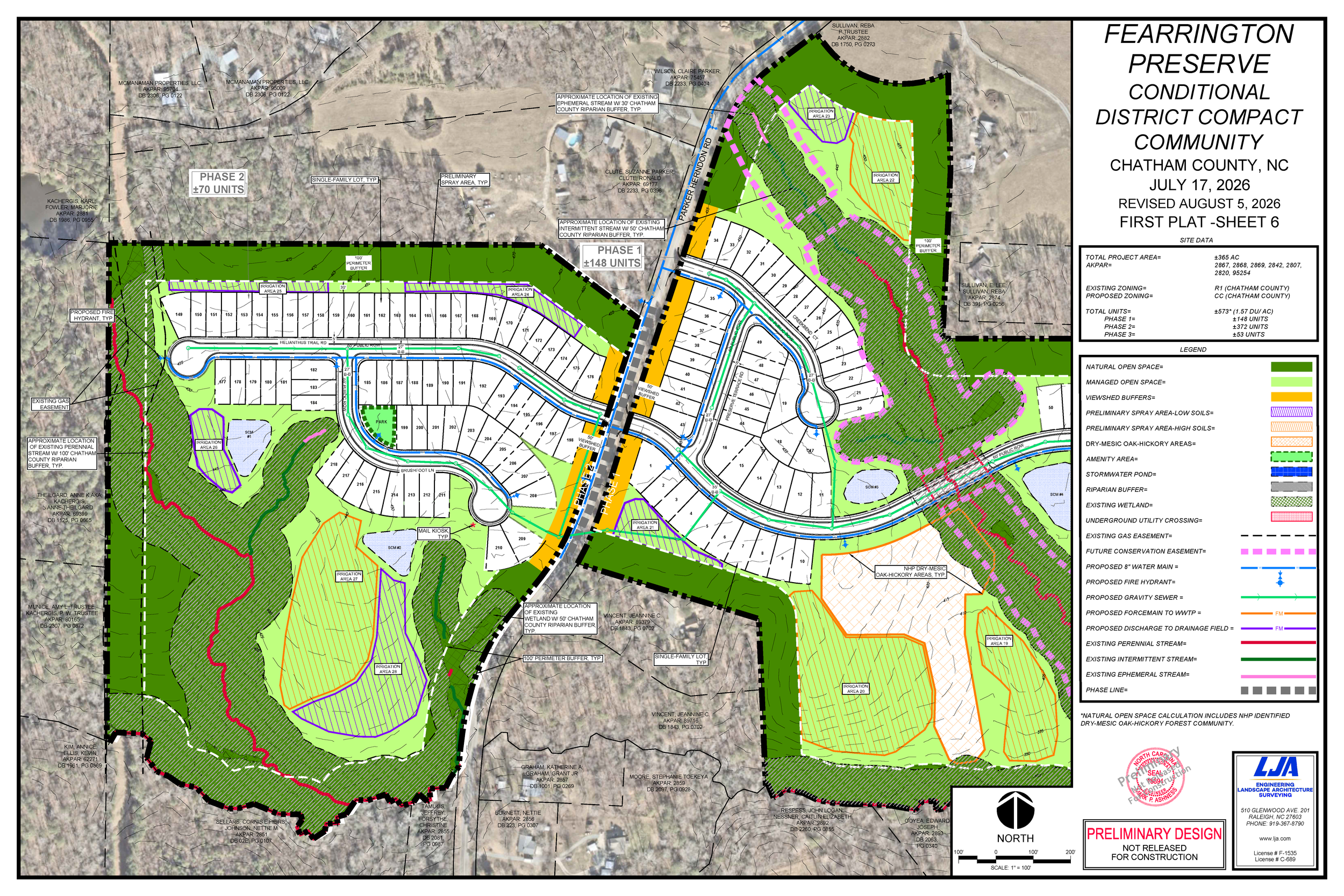
Fearrington Preserve First Plat Set
Scroll through the first plat submitted on August 11th 2026. Including overall land use, section details, affordable housing layouts and utility plans. Click any sheet to view full screen.




Search 2,198+ Pages of Official County Records with AI
We indexed all official Chatham County application filings, TRC technical reviews, EIA Version 5 environmental reports, Traffic Impact Analyses (TIA), Zoning Administrator rulings, and public hearing transcripts into our public NotebookLM workspace.
Launch NotebookLM
Query source documents directly using natural AI search.
September 1 Planning Board Meeting
Watch the video archive of the marathon September 1st session, featuring citizen public comments and community testimony.
Citizen Public Comments Playlist
Over 200 citizens attended this marathon session to speak out for policy-compliant growth. Use the player controls to play through the sequence, or click below to view the full video list on YouTube.
Open & Browse All Videos on YouTube →- Extensive turnout with over 200 community members present
- Dozens of residents deliver 3-minute public comments
- Planning Board votes to table recommendation until Oct 6th
Past Board of Commissioners Public Hearings
Watch the full recorded proceedings from the three open hearings where late plan overhauls, traffic concerns, and sewer rulings unfolded.
Initial Application & Staff Presentation
First open hearing introducing the 383-acre CD-CC rezoning proposal by Fearrington Property Development.
- Staff overview of the complex 383-acre proposal
- Traffic impact concerns on local collector roads
- Waiver requests for commercial space reductions
Developer Presentation & Delay
Developer legal and engineering team presented Pokeberry Creek flood plans before hearing was postponed.
- Presentation by developer's technical team
- Pokeberry Creek flood restoration plan details
- Board postponed hearing due to information gaps
100+ Pages of Plan Revisions
Developer introduced late plan overhauls. Staff confirmed off-site wastewater treatment is barred without rezoning.
- Staff confirms off-site sewer is legally barred
- Late plan revisions added affordable units & roundabouts
- Public pushback regarding statutory notice requirements
Frequently Asked Questions
Direct facts and official clarifications surrounding the Fearrington Preserve CD-CC rezoning proposal.
What is the scope of the Fearrington Preserve rezoning request?
Fearrington Property Development LLC is requesting to rezone 365 acres off Andrews Store Road, Parker Herndon Road, and Morris Road from R1 Residential to Conditional District Compact Community (CD-CC) to build up to 630 residential units. However, this proposal fails to comply with the intent of Chatham County's Compact Community Ordinance. The developer is asking for double the standard residential density while seeking extensive waivers, including slashing required commercial space by approximately 77% and cutting roadside viewshed buffers by 50% along Parker Herndon and Morris Roads.
What is the status of the wastewater and sewer infrastructure?
The development will not connect to a municipal sewer system and instead relies on a privately-owned, on-site Membrane Bioreactor (MBR) wastewater plant with effluent spray irrigation fields located near floodplains. Privately operated wastewater facilities pose long-term environmental risks, as demonstrated by saturated spray grounds and costly maintenance issues in other northeast Chatham developments. Furthermore, County Zoning Administrator Angela Plummer officially confirmed that running sewer lines off-site to Fearrington Place is strictly prohibited without undergoing a separate formal rezoning process.
How are local traffic and intersection impacts being addressed?
The development is projected to generate 5,000 to 6,000+ new daily vehicle trips, causing a 7-fold traffic increase on secondary rural roads like Parker Herndon Road. It will add 450 to 550+ vehicles directly into the 7:00 AM – 9:00 AM morning peak hours for four nearby schools (Margaret B. Pollard Middle, Chatham Grove Elementary, Woods Charter, and Willow Oak Montessori). Rather than providing immediate roadway improvements, the developer has only offered to fund a traffic signal warrant analysis after 300 certificates of occupancy are issued, leaving the community to absorb severe gridlock (LOS E and F) in the interim.
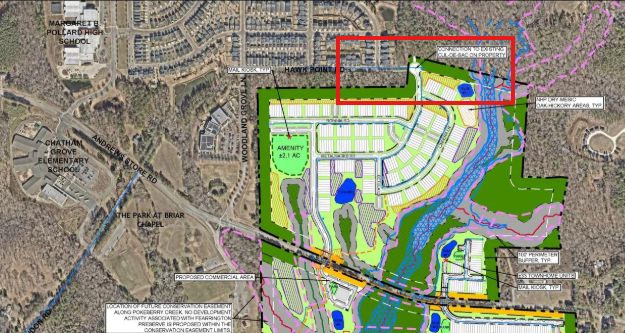
How will the Hawk Point connection affect cut-through traffic in Briar Chapel?
The proposed vehicular connection via Hawk Point establishes a direct bypass route, encouraging drivers to cut through Briar Chapel to avoid main road congestion and roundabouts. Channeling hundreds of external commuters through tight, narrow neighborhood streets—originally engineered strictly for low-volume local traffic—creates severe pedestrian safety hazards for children and walkers, increases noise, and accelerates street degradation without any traffic-calming safeguards for existing residents.
What are the key terms regarding affordable housing?
While up to 72 affordable housing units are proposed, they are contingent on complex land-swap agreements. If the County declines the land donation, the commitment drops by half to 36 lots. Additionally, capping master HOA dues at $600 per year per unit only lasts for 10 years, exposing lower-income homeowners to substantial fee increases in year 11.
What is the Pokeberry Creek mitigation project?
Although a stream restoration easement is proposed, the site layout relies on outdated FEMA flood maps along Pokeberry Creek, where severe flooding has already washed out the Morris Road bridge twice in seven years. Deforesting over 100 acres of mature woods will increase annual stormwater runoff by approximately 125 acre-feet, elevating flood risks downstream and putting further strain on local ecosystems.
Who is financially responsible if the private wastewater plant fails?
There is significant financial liability for local taxpayers and future property owners. Fearrington Preserve is structured as a speculative horizontal land entitlement financed primarily by advance builder deposits from NVR, Inc. (Ryan Homes) through a network of Special Purpose Vehicles (SPVs). Should the private utility encounter structural failures or operational deficits, these special-purpose LLCs offer no balance-sheet guarantee to the county.
Were there transparency issues during the public hearing process?
Yes. Over 100 pages of late master plan revisions were introduced during public hearings, while the County executed a Non-Disclosure Agreement (NDA) during discussions. Conducting development negotiations under non-disclosure constraints compromises public accountability. Furthermore, making substantial design revisions without fresh statutory public notification deprives nearby residents of due process.
Is this project a true "Compact Community"?
No. Community advocates and planning researchers characterize this proposal as high-density suburban sprawl, referred to as "CC creep," expanding beyond designated compact development zones. Rather than functioning as a cohesive village, the site relies on five separate roadway entrances spread across three different rural roads.
Full Transparency: Review the Developer’s Submittal and Our Planning Board Brief Side-by-Side
Ahead of this week’s Chatham County Planning Board review of the Fearrington Preserve rezoning request (CD-CC-2026), we believe community members deserve unedited access to all primary submittals.
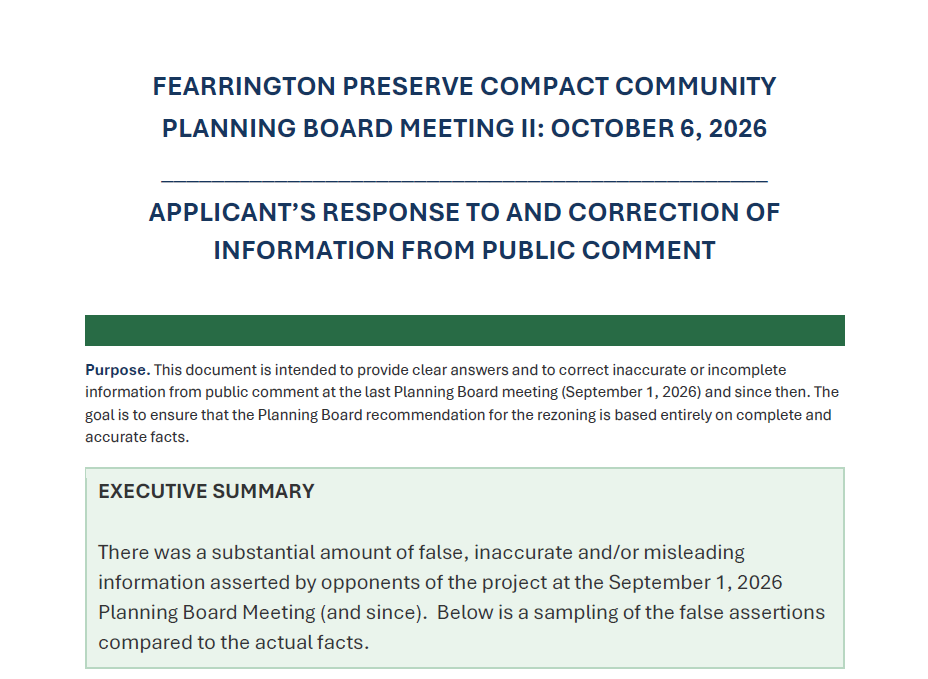
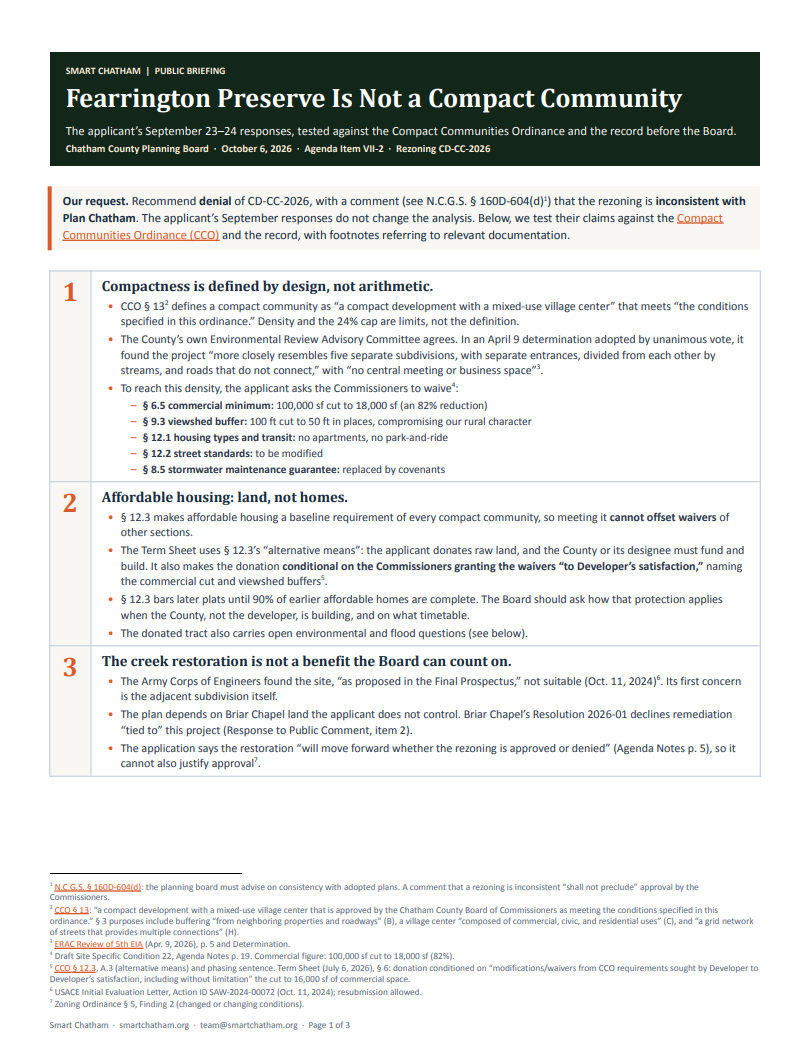
Below, you can review the complete document submitted by the developer’s team in response to prior public comments, alongside the technical brief Smart Chatham has formally submitted to the Planning Board rebutting those claims. Examine the facts, compare the ordinance standards, and draw your own conclusions before the upcoming public hearing.
1. The Developer's Response Document
2. Smart Chatham Rebuttal Brief
Why We Posted Both Documents: Key Policy Contrasts
When tested against Chatham County's Compact Communities Ordinance (CCO) and the official public record, several core claims made by the applicant require objective technical scrutiny:
1. Compactness: Design vs. Arithmetic
Developer Claim: Compactness is defined strictly by meeting broad numerical limits on overall density, net density, and impervious surface percentages.
Ordinance Reality: CCO § 132 defines a compact community by design—requiring an integrated, walkable mixed-use village center, a connected street grid, and balanced housing types. The site plan splits 630 homes into isolated pods separated by floodplains and roads, while requesting waivers to slash commercial space by ~82% (from 100,000 sq. ft. down to 18,000 sq. ft.) and cut viewshed buffers in half.
2. Affordable Housing Structure
Developer Claim: The project fulfills inclusionary commitments through an affordable housing land donation.
Ordinance Reality: Under CCO § 12.3, affordable housing is a baseline requirement for all compact community proposals, not a trade-off to justify waiving core commercial or environmental buffers. Furthermore, the term sheet transfers the multi-million dollar vertical construction and long-term financing burden entirely onto county taxpayers and non-profit partners.
3. Pokeberry Creek Stream Mitigation
Developer Claim: Stream restoration along Pokeberry Creek will deliver substantial environmental benefits to the watershed.
Ordinance Reality: The U.S. Army Corps of Engineers determined the restoration prospectus was not suitable as proposed due to unaddressed site risks. Additionally, the plan relies on access to downstream Briar Chapel HOA land that is not under applicant control.
4. School Corridor Infrastructure & Traffic
Developer Claim: Over 50 roadway improvements fully mitigate traffic impacts along school corridors.
Ordinance Reality: Key intersection assumptions rely on NCDOT state STIP highway projects that the developer neither builds nor funds. Draft conditions set no construction schedule, bonding guarantees, or explicit requirement to construct proposed roundabouts prior to building homes.
Got Receipts? An Open Invitation to the Developer
We’ve heard the chatter that our math is a bit too "spicy" and our callouts are "fake news." Since every single stat cited in our materials comes directly from public records, expert testimony and Chatham County staff reports, we’re more than happy to make any corrections—if someone shows us where we misread the fine print.
Our Promise to the Community
Smart Chatham is built on facts, transparency, and public record integrity. We don't invent numbers—every statistic we reference in our content and briefings comes directly from official records, expert testimony, county filings and staff reports.
We rely strictly on verified public records, FOIA acquired documents, staff memos, and public hearing testimony.
If official filings change, new public data is submitted to the county or verifiable errors are brought to our attention we will update our published materials within 24 hours.
We welcome scrutiny, questions, and official clarifications from all parties—including developers, engineers, and county staff.
Submit a Fact-Check or Unreleased Data
Are you part of the development team, an engineer, or a representative with unreleased site context? Help us fill in the gaps!