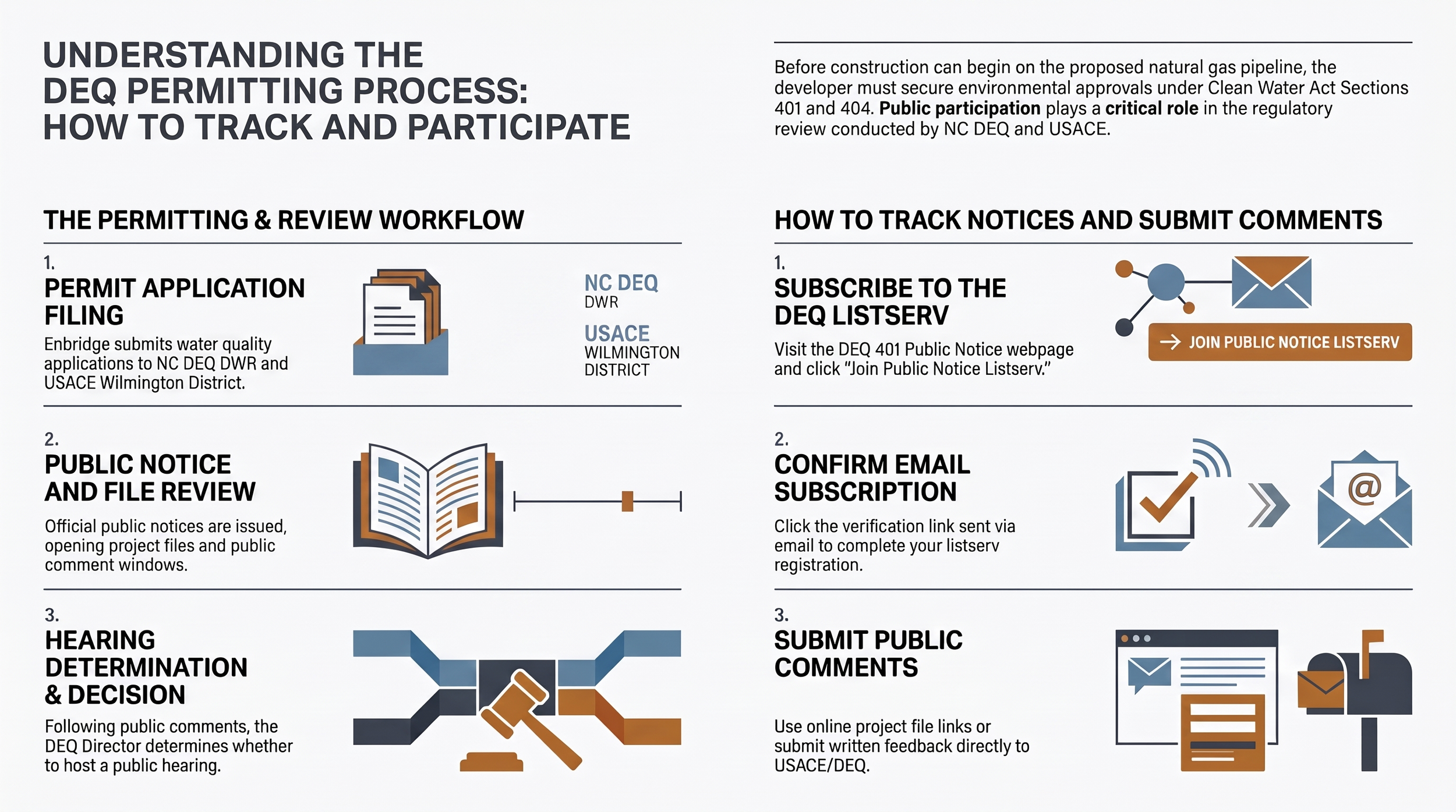
How to Monitor State & Federal Filings, Demand a Local Hearing, and Protect Chatham’s Waterways
The Current Situation
Enbridge Gas North Carolina is finalizing its filings for two major environmental permits to construct an approximately 28-mile, 12-inch high-pressure fracked-gas pipeline cutting across western and southern Chatham County.
Because this pipeline is purely intrastate, the Federal Energy Regulatory Commission (FERC) has no siting jurisdiction. That means the primary regulatory choke points to delay, challenge, and stop this project rest with state and federal water protection agencies:
The North Carolina Department of Environmental Quality (NCDEQ) – Division of Water Resources (DWR): Must decide whether to issue a Clean Water Act Section 401 Water Quality Certification and Jordan/Cape Fear Riparian Buffer Authorizations.
The U.S. Army Corps of Engineers (USACE) – Wilmington District: Evaluates stream and wetland crossings under Clean Water Act Section 404.
Coalition leaders recently spoke directly with Paul Wojoski, Water Quality Permitting Chief for NCDEQ, to establish exact procedures for tracking permit applications, accessing project files, and submitting formal public comments.
Below is your complete step-by-step guide to monitoring the public docket, ensuring our community receives timely notice, and holding regulators accountable.
How the Permitting & Public Notice Process Works
Status of the 401 Application: NCDEQ confirmed that as of mid-October, Enbridge had not yet formally submitted its completed 401 application, but filings are anticipated imminently.
Potential Combined Notice via the Army Corps: Because the project application covers both Section 401 (state water certification) and Section 404 (federal dredge-and-fill permits), public notice may be coordinated primarily through the U.S. Army Corps of Engineers.
Comments Carry Over: If public notice is issued exclusively through the USACE, all public comments submitted to the Army Corps are automatically transmitted to NCDEQ’s Division of Water Resources and incorporated into the state's official 401 review.
3 Immediate Steps Every Chatham Resident Should Take
1. Sign Up for the NCDEQ Public Notice Listserv
Do not rely on the pipeline company to inform you when permit reviews begin. Sign up directly with NCDEQ to receive immediate alerts when 401 applications are docketed[11]:
Public Notice Portal: Visit the NCDEQ 401 Public Notices Page.
Join the Listserv: Click on the tab labeled “Join Public Notice Listserv” and enter your email address.
Important Confirmation Step: NCDEQ will immediately email you a verification link. You must click the confirmation link in that email to activate your subscription.
Track Natural Gas Projects Statewide: You can also track updates on pipeline reviews via NCDEQ’s Natural Gas Pipeline Projects Page.
2. Monitor the U.S. Army Corps of Engineers (USACE) Notices
Because public notices may be posted first through the federal review track, bookmark the Wilmington District portal:
USACE Regulatory Request System: Visit USACE Public Notices.
Once a project file opens, it will contain all technical documents, route crossing alignments, and formal submission links to register public objections.
3. Know the Rules Governing Public Hearings
Under North Carolina Administrative Code (15A NCAC 02H .0503), NCDEQ’s Division Director determines whether to hold an official public hearing after the initial public comment period closes.
Public hearings are not granted automatically—we must demand them.
Our Coalition's Three Demands to NCDEQ & USACE
We are putting "sand in their gears" by demanding maximum administrative and legal scrutiny:
Reject Fast-Track General Permits: Enbridge must not be allowed to slip this 28-mile greenfield project through streamlined Nationwide Permit 12 or state general permits. We demand an Individual 401 Water Quality Certification and an Individual Section 404 Permit.
Hold the Official Public Hearing IN Chatham County: Regulatory agencies must not hold hearings in Raleigh or Wake Forest. The hearing must take place directly in Chatham County (such as the Chatham County Agriculture & Conference Center in Pittsboro) so frontline landowners and affected families can participate without travel barriers.
Examine Practicable Alternatives First: Under Clean Water Act rules (15A NCAC 02H .0506 and 40 C.F.R. § 230.10(a)), permits cannot be granted if feasible, less damaging alternatives exist. The North Carolina Utilities Commission (NCUC) must be required to review hydraulic modeling and existing-system alternatives (like compression or reinforcement along existing utility rights-of-way) before any environmental destruction is authorized.
Take Action Today
Send a 1-Click Message to NCDEQ: Use our automated email tool to contact Stephanie Goss, Supervisor of the NCDEQ 401 Buffer & Permitting Branch, demanding an individual permit and a Chatham hearing.
Know Your Landowner Rights: If Enbridge land agents contact you seeking survey access or offering easement contracts, remember that under N.C.G.S. § 40A-11, you do not have to give immediate consent. Connect with independent eminent domain counsel immediately.
Get Involved: Join our volunteer strike teams (Canvassing, Tabling, and Content) or attend an upcoming meeting by visiting fightenbridge.org.
(Special thanks to coalition member Bill Dannelly for contacting NCDEQ leadership and compiling this procedural briefing*. For questions or a copy of the official DEQ email correspondence, contact swilliamd@icloud.com.)*