A Striking Difference in Pipeline Easement Values
Dominion’s 2020 Proposal Versus Enbridge’s 2026 Chatham County Project
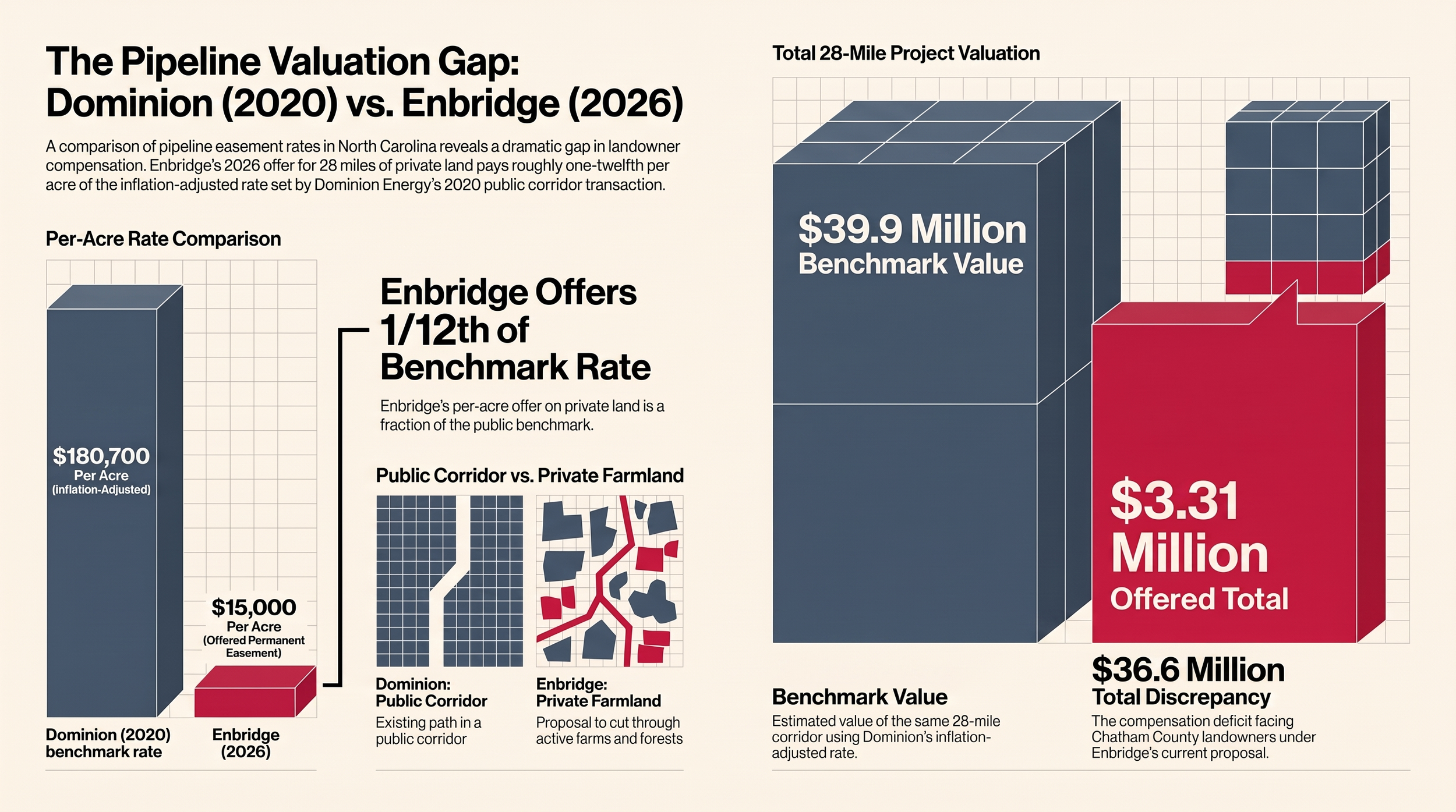
In May 2020, the North Carolina Department of Transportation (NCDOT) approved a proposed payment of $3 million from Dominion Energy for pipeline easement rights along approximately six miles of the American Tobacco Trail (ATT). The proposed pipeline would have been installed mostly using horizontal directional drilling (HDD), reducing surface disturbance along the existing public corridor. Using a 30-foot-wide corridor, the six-mile easement represented approximately 21.8 acres. The $3 million payment was equivalent to approximately $137,500 per acre in 2020. Adjusted for inflation, that payment would equal approximately $3.94 million today, or $180,700 per acre.
Now compare that transaction with Enbridge Gas North Carolina's proposed 28-mile natural gas pipeline across Chatham County. Enbridge plans to acquire a 50-foot-wide permanent easement and an additional 30-foot-wide temporary construction easement, creating an 80-foot construction corridor. Over 28 miles, the permanent easement would occupy approximately 169.7 acres, while the temporary easement would occupy another 101.8 acres. Altogether, approximately 271.5 acres of land would be affected, assuming a continuous 80-foot corridor.
An actual Enbridge easement offer dated October 16, 2026, establishes that the company is offering $15,000 per acre for permanent easements and $7,500 per acre for temporary construction easements on at least one affected Chatham County property. Applying these rates uniformly to the proposed 28-mile pipeline produces an estimated total payment of $2.55 million for permanent easements and $764,000 for temporary easements, or approximately $3.31 million altogether.
What would the same 28-mile corridor cost using NCDOT's 2020 ATT payment as a benchmark, adjusted to today's dollars? At approximately $180,700 per acre, the 169.7 acres of permanent easement alone would be valued at $30.7 million. If temporary easements were valued at half that rate, the additional 101.8 acres would represent approximately $9.2 million, producing a combined total of $39.9 million. Using the full benchmark for both permanent and temporary acreage would produce approximately $49.1 million.
The difference is substantial. Enbridge's actual offered permanent easement rate of $15,000 per acre is approximately one-twelfth of the inflation-adjusted rate implied by NCDOT's proposed ATT transaction. Across the entire project, the comparison produces approximately $3.3 million using Enbridge's offered rates versus $39.9 million using the ATT benchmark with temporary easements valued at half the permanent rate.
There are important differences between the projects. Dominion proposed using an existing public corridor with mostly HDD construction, while Enbridge proposes crossing privately owned land, including farms and forests, with substantial surface disturbance. The ATT payment was a negotiated government transaction, not necessarily an appraisal of private land values. Likewise, the temporary easement valuation used in this comparison is illustrative.
Nevertheless, these figures raise an important public question: How can a six-mile pipeline easement along an existing public corridor have commanded a proposed payment of $3 million in 2020, while Enbridge is offering rates that would total only about $3.3 million for easements along 28 miles of a new pipeline through private Chatham County properties in 2026?
This comparison deserves careful examination by Chatham County officials, affected landowners, and the North Carolina Utilities Commission before the proposed pipeline moves forward.