The "Paper Trail" of Incompetence: How the Fearrington Preserve Developer Failed Basic Environmental Due Diligence
If you have spent any time listening to the representatives of Texas-based real estate speculator Sheridan Road Properties, you have heard a beautifully polished story. They promise a pristine, low-impact, eco-friendly "Preserve". They tell the Chatham County Board of Commissioners and our Planning Board that they are highly experienced, responsible professionals who will manage our soil, water, and forests with the utmost care.
But as one local resident sharply observed during the very first Board of Commissioners public hearing: "They haven’t done their homework."
Now, thanks to the release of critical technical files previously concealed under the developer's private June 4, 2026 Confidentiality Agreement, we have another example to prove it.
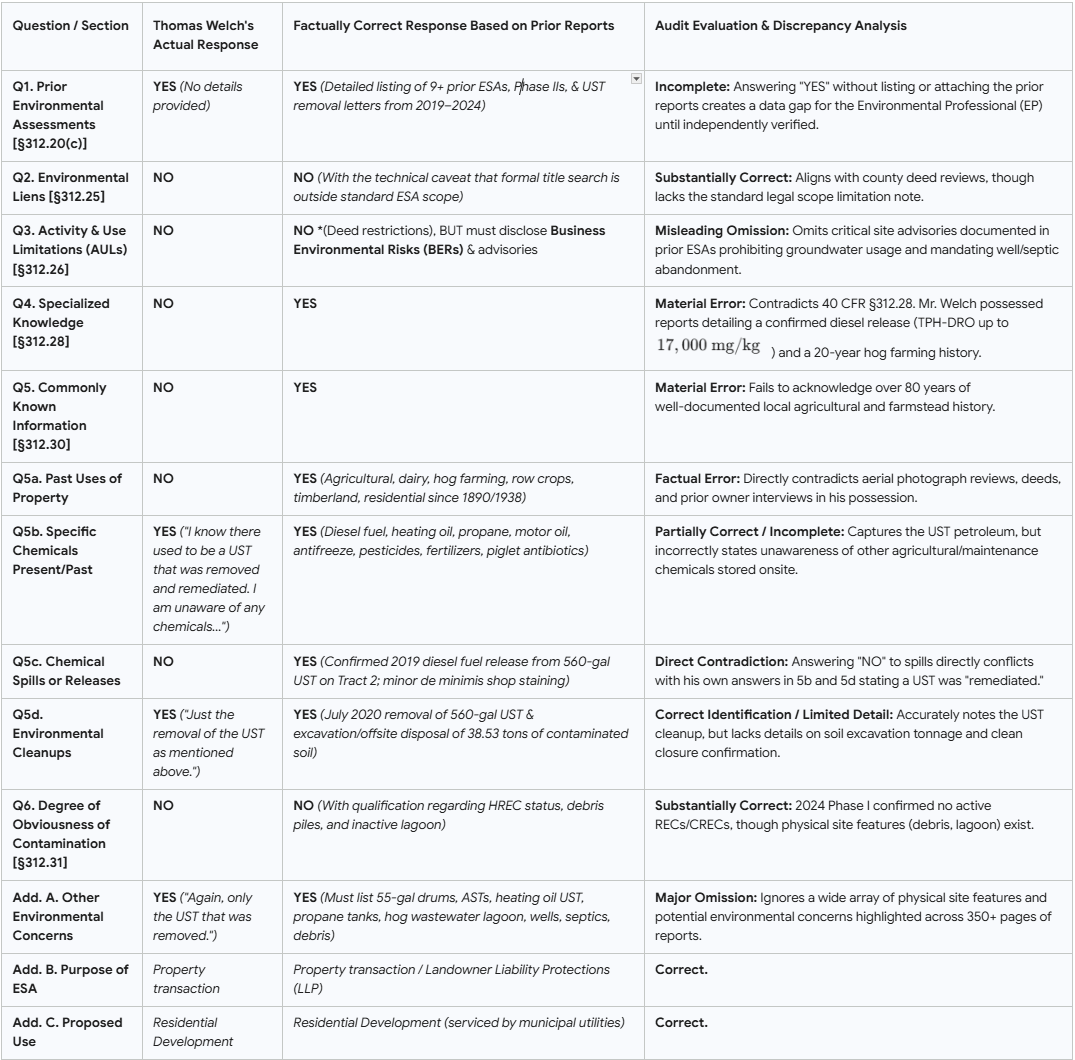
To satisfy the due diligence requirements for their proposed 8.40-acre affordable housing land donation, the developer was required to commission an Environmental Update for Phase I ESA report. As part of this process, the developer's Managing Partner, Thomas Welch, was required to fill out a standard environmental questionnaire.
The results of this questionnaire are a devastating display of either active concealment or jaw-dropping administrative incompetence. When compared side-by-side with more than 350 pages of scientific reports in Welch’s direct possession, his legally binding answers completely crumble.
The Anatomy of a Cover-Up: Thomas Welch's Questionnaire vs. Reality
Under federal law (the All Appropriate Inquiries rule), an applicant must disclose any "specialized knowledge" or historical environmental liabilities associated with the land. Here is how Thomas Welch answered, compared to the hard, scientific facts documented by his own environmental firms:
1. The Spills and Releases Deception
Thomas Welch's Legally Signed Response: He answered "NO" to having any knowledge of chemical spills or petroleum releases on the property.
The Scientific Reality: Welch’s own files contained S&EC’s December 2019 Phase II Limited Soil Assessment. This report documented a catastrophic petroleum release on Tract 2 where soil samples beneath the diesel dispenser dispenser (Sample DT-2) exhibited 17,000 mg/kg (PPM) of Diesel Range Organics (TPH-DRO). That is 170 times the state action limit.
The Contradiction: In the very same document, Welch noted that a UST was "removed and remediated." From a planning and legal perspective, remediation legally and practically presupposes a release. Answering "NO" to spills while acknowledging "remediation" is a glaring, logic-defying contradiction.
2. Denying the Toxic "Hog Lagoon" and Legacy Farms
Thomas Welch's Legally Signed Response: He answered "NO" to knowing of any past agricultural uses that could present environmental hazards.
The Scientific Reality: The site has been farmed since at least 1890, including a massive 20-year hog farming operation on Tracts 6 and 7. This operation featured an unpermitted, unlined waste lagoon west of the hog barn where feces, urine, and barn washdown sat for two decades.
3. Hiding the Site-Wide "Groundwater Ban"
Thomas Welch's Legally Signed Response: He answered "NO" to knowing of any Activity and Use Limitations (AULs) or site advisories.
The Scientific Reality: Previous Phase I reports explicitly issued a sweeping site-wide directive warning that onsite groundwater must NOT be used for any purpose due to legacy agricultural chemicals and petroleum residues. Furthermore, WithersRavenel noted that "layers of topsoil may be required to facilitate vegetative growth" in the former hog lagoon areas due to deep pathogen and salt saturation.
The Omission: Welch withheld this critical, active land restriction. To this day, the developer is actively attempting to build 573 homes without disclosing that their own environmental firm declared the local water table unsafe to touch.
4. The "Invisible" Utility Infrastructure
Thomas Welch's Legally Signed Response: Welch claimed he was unaware of other environmental features, restricting his answers to "only the UST that was removed."
The Scientific Reality: The site is littered with physical, high-risk environmental features documented in prior reports, including:
An active residential propane UST and multiple propane ASTs.
A former 250-gallon diesel fuel Aboveground Storage Tank (AST) on Tract 6.
Dozens of 55-gallon fuel and chemical drums in the shop and dairy barns.
At least three private water supply wells and multiple active septic tanks.
Three scattered debris dumping areas containing scrap metal, plastics, and waste.
The Omission: Welch simply pretended these features did not exist on the legal questionnaire.
Are These the People We Trust with Our Community's Future?
This questionnaire is not an isolated administrative slip-up. It is a defining pattern of behavior. The developer has repeatedly relied on a "don't look, don't tell" strategy to secure their high-density entitlements:
The developer of the day lobbies the county in 2021 to expand the Compact Community boundary, promising that soil safety and utility feasibility will be reviewed later.
A new developer returns in 2026, pointing to the 2021 CCO expansion as an "external changed condition" to force an approval.
They hide their soil suitability and groundwater reports under a secret NDA while rushing a public hearing.
And when forced to fill out due diligence forms for a land donation, their managing partner signs off on blank explanations, factual errors, and blatant omissions of known contamination.
So much of this project is built on empty, developer-enforced promises. The action we have seen to date doesn't lend a single ounce of faith to those promises coming true.
If they cannot accurately fill out a basic, 5-page environmental questionnaire, how can we trust them to safely construct and operate a high-intensity, private wastewater package plant and spray irrigation field next to Pokeberry Creek? How can we trust them to manage the health of our streams, the preservation of our forests, and the welfare of the families who will buy these homes?
Chatham County deserves better than out-of-state private equity speculators who refuse to do their homework.
——————————————————————————————————————
1. Executive Summary
This audit report evaluates the responses provided by Thomas Welch on the ASTM E1527-21 / 40 CFR Part 312 Client/User Questionnaire against the objective findings recorded in historical environmental site assessments (ESAs) and remediation reports.
While Mr. Welch correctly identified the primary historical issue—the removal and remediation of a 560-gallon diesel Underground Storage Tank (UST) on Tract 2—his submission contains significant omissions, internal contradictions, and factual inaccuracies regarding site history, chemical storage, releases, and physical features. Most notably, Mr. Welch answered "NO" to having specialized knowledge, knowing past site uses, and knowing of chemical spills, despite possessing prior reports that explicitly document a confirmed petroleum release, historical hog farming operations, an unpermitted wastewater lagoon, aboveground storage tanks (ASTs), chemical/drum storage, and private wells/septic systems.